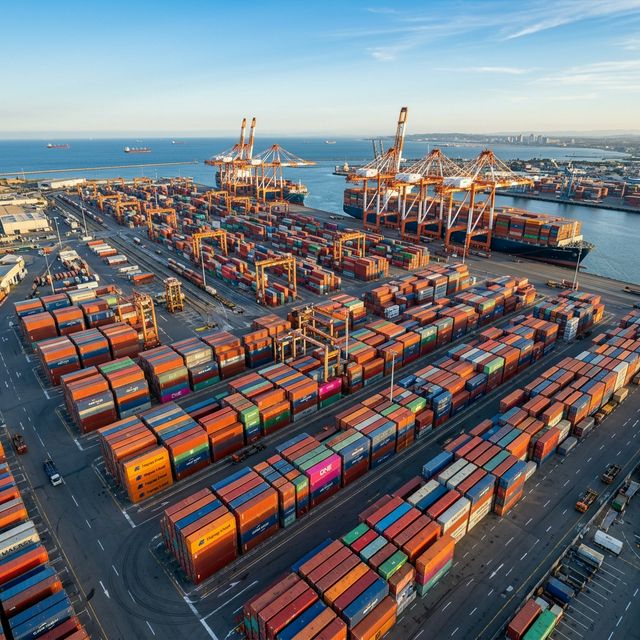
Sourcing polyester fabric from China is only half the equation. How you ship it—whether by Full Container Load (FCL) or Less than Container Load (LCL)—can significantly affect your landed cost, lead time, and cargo condition. For buyers of home textile fabrics, getting this decision right has a direct impact on competitiveness downstream.
This guide walks through the practical considerations that matter for polyester fabric shipments, from cost breakpoints and container math to Incoterms selection and cargo protection.
Understanding the fundamentals
FCL (Full Container Load) means booking an entire shipping container for your exclusive use. Your fabric rolls are loaded at the origin—typically the mill or a nearby depot—and the container is sealed until it reaches your destination. No other shipper's goods share the space.
LCL (Less than Container Load) means your shipment is consolidated with cargo from other shippers at a Container Freight Station (CFS). You pay for the cubic meters you use rather than an entire container. At the destination CFS, your goods are separated from the consolidated load before final delivery.
Both methods use the same ocean vessels and trade routes. The key difference lies in handling, timing, and how costs scale with volume.
The cost crossover: when FCL beats LCL
LCL pricing is typically quoted per cubic meter (CBM) with a minimum charge, while FCL is a flat rate per container regardless of how full it is. The economics look roughly like this:
| Shipment size | Typical cost advantage | Why |
|---|---|---|
| Under 8 CBM | LCL | Per-CBM rate is far lower than paying for an empty half-container |
| 8–15 CBM | Depends on trade lane | Calculate both; LCL surcharges and CFS fees may tip the balance |
| Over 15 CBM | FCL (20' container) | Flat rate per container becomes cheaper per CBM than LCL premiums |
| Over 30 CBM | FCL (40' or 40' HC) | Significant savings; nearly always FCL territory |
These thresholds shift with market conditions, trade lane congestion, and seasonal freight volatility. During peak season (typically August–October for ocean freight), LCL space can tighten and surcharges rise, pushing the crossover point lower. Savvy buyers request quotes for both options from their freight forwarder at every order to check.
Container math for polyester fabric
Polyester fabric rolls are bulky relative to their weight—a common challenge in textile shipping. A standard roll of peachskin fabric at 150 cm width and 1,500 meters might measure roughly 0.35–0.5 CBM but weigh only 100–150 kg. This means containers typically "cube out" (fill by volume) long before they "weigh out" (reach the weight limit).
Here's how standard container capacities map to fabric shipments:
| Container type | Internal volume | Max payload | Typical fabric capacity |
|---|---|---|---|
| 20' Standard | ~33 CBM | ~21,700 kg | 40,000–60,000 meters |
| 40' Standard | ~67 CBM | ~26,500 kg | 80,000–130,000 meters |
| 40' High Cube | ~76 CBM | ~26,300 kg | 100,000–150,000 meters |
Actual capacity depends on roll dimensions, fabric weight (GSM), and how efficiently rolls are stacked. Weaverine can produce fabric widths from 160 cm to 330 cm, which affects roll diameter and stacking geometry. Wider fabrics produce bigger-diameter rolls that leave more void space between them.
Practical tip: When planning a first FCL shipment, share your product specifications with both the supplier and freight forwarder. Confirm the expected number of rolls, individual roll dimensions, and total CBM before booking. Over-estimating is far less costly than finding your rolls don't fit.
Beyond cost: transit time, handling, and risk
Transit time
FCL shipments typically arrive 5–10 days faster than LCL on the same trade lane. LCL requires consolidation at origin (1–3 days waiting for other cargo) and deconsolidation at destination (1–2 days at the CFS). These extra handling steps add up.
For time-sensitive programs—sampling windows, seasonal launches, or replenishment orders—this difference matters. A two-week difference in fabric arrival can cascade through the downstream production timeline for bedding products or curtains.
Cargo handling
Every time cargo is physically moved—forklift, crane, manual repositioning—there's risk of damage. FCL involves two major handling events (loading and unloading). LCL can involve four to six, including transfer to and from the CFS at both ends.
Polyester fabrics are generally hardy, but they're not damage-proof. Risks include:
- Crush damage from heavy cargo stacked above (LCL), which can deform rolls and crease fabric
- Moisture exposure during CFS staging, which can cause mildew on greige or bleached fabric
- Cross-contamination from oils, chemicals, or odours from other shippers' cargo (LCL only)
- Roll end damage from rough handling between transfer points
For greige fabric destined for downstream dyeing or finishing, even minor contamination can lead to quality issues downstream. FCL's sealed container environment essentially eliminates cross-contamination risk.
Insurance and liability
Cargo insurance premiums for LCL are often marginally higher due to the additional handling. More importantly, claim resolution can be more complex when multiple shippers' goods share a container. If damage occurs, determining liability between the CFS operator and the carrier adds steps.
Choosing your Incoterms: where shipping meets sourcing
The shipping method you choose interacts directly with your Incoterms agreement. Here's how common terms align with FCL and LCL:
| Incoterms | Recommended shipping | Why |
|---|---|---|
| EXW | Either, with strong forwarder | Buyer arranges everything; full logistics control |
| FOB | FCL preferred | Seller handles to port; buyer controls ocean leg |
| CIF | Either | Seller arranges freight and insurance; buyer has less logistics control |
| DDP | Either | Seller handles door-to-door; buyer receives goods at destination |
FOB is the most common Incoterms basis for fabric exports from China. In an FOB arrangement, the seller (Weaverine) is responsible for costs and risk up until the goods are loaded onto the vessel at the origin port. This gives the buyer flexibility to negotiate ocean freight rates, choose carriers, and decide between FCL and LCL based on their own logistics network.
For buyers new to importing, CIF or DDP simplifies logistics—the supplier arranges freight—but typically at a higher total cost and with less control over the shipping method and carrier selection.
Documentation essentials
Regardless of FCL or LCL, international fabric shipments require proper documentation. Key documents include:
- Bill of Lading — The shipping contract between seller and carrier. FCL shipments receive a "clean" B/L for the whole container; LCL receives a house B/L from the consolidator.
- Commercial Invoice — Details the transaction value and goods description for customs.
- Packing List — Lists individual rolls, weights, and dimensions; essential for both customs clearance and cargo reconciliation.
- Certificate of Origin — Verifies Chinese origin for tariff calculations in the destination country.
- GRS Certificate — Required if shipping regenerated polyester fabrics and claiming recycled content.
For LCL, ensure your packing list and markings are exceptionally clear. Your cargo will be mixed with others, and CFS workers need easy identification. Unique shipping marks on every roll are not optional—they're essential.
Protecting your fabric in transit
Polyester fabric is reasonably resilient, but ocean transit can be punishing. Containers routinely experience temperature swings from 0°C to 60°C, humidity fluctuations, and vibration. Best practices for protection:
- Moisture barrier — Each roll should be wrapped in polyethylene film. For bleached white and light-colored solid dyed fabrics, this is critical to prevent yellowing from humidity.
- Desiccant packs — Place silica gel or calcium chloride desiccant inside the container (FCL) or within your shipment packaging (LCL) to manage humidity.
- Cardboard tube protection — Ensure rolls are wound on sturdy cores. Collapse from weak cores causes permanent creasing.
- Stacking direction — Rolls should be loaded with cores horizontal and secured against shifting. Never stack rolls more than three high without intermediate support.
- Container inspection (FCL) — Before loading, inspect the container for holes, rust, residual odours, and moisture. Reject containers that don't pass—a few minutes of inspection can prevent thousands of dollars in damage claims.
When to start with LCL and when to go FCL
The decision isn't always static. Many of Weaverine's international buyers follow a natural progression:
- Trial orders and samples → LCL. You're testing the product and the supplier. Keep volumes small and flexible.
- First production orders (5,000–20,000 meters) → Calculate both. If you're ordering mixed products from our range of fabrics, an LCL shipment may make sense if the total CBM stays under 12.
- Recurring programs (20,000+ meters per order) → FCL almost always. Negotiate FOB terms and build a relationship with a dedicated freight forwarder.
- Large seasonal bookings → Multiple FCLs. For high-volume home textile programs, booking container space well in advance can lock in better rates. Work with your forwarder on a shipping schedule that aligns with your production timeline.
How Weaverine supports your logistics
With over 30 years of textile export experience and shipments to markets across Europe, the Americas, and the Middle East, Weaverine's team can help you navigate shipping logistics from day one:
- Accurate CBM estimates before you book, based on actual roll dimensions for your specific fabric specification
- Export documentation prepared to your requirements, including bills of lading, commercial invoices, and packing lists
- FOB, CIF, and DDP pricing available—choose the Incoterms basis that fits your logistics capability
- Loading supervision at our Anhui facility to ensure rolls are properly packed and containers are correctly loaded
Ready to plan your next shipment? Use our AI Assistant for quick estimates on shipping volumes and lead times, or contact our sales team at info@weaverine.com for a detailed quotation.